

A New Year's Resolution: Dust off that Resume
The Arte of Finding a New Job, Part 5 of Many


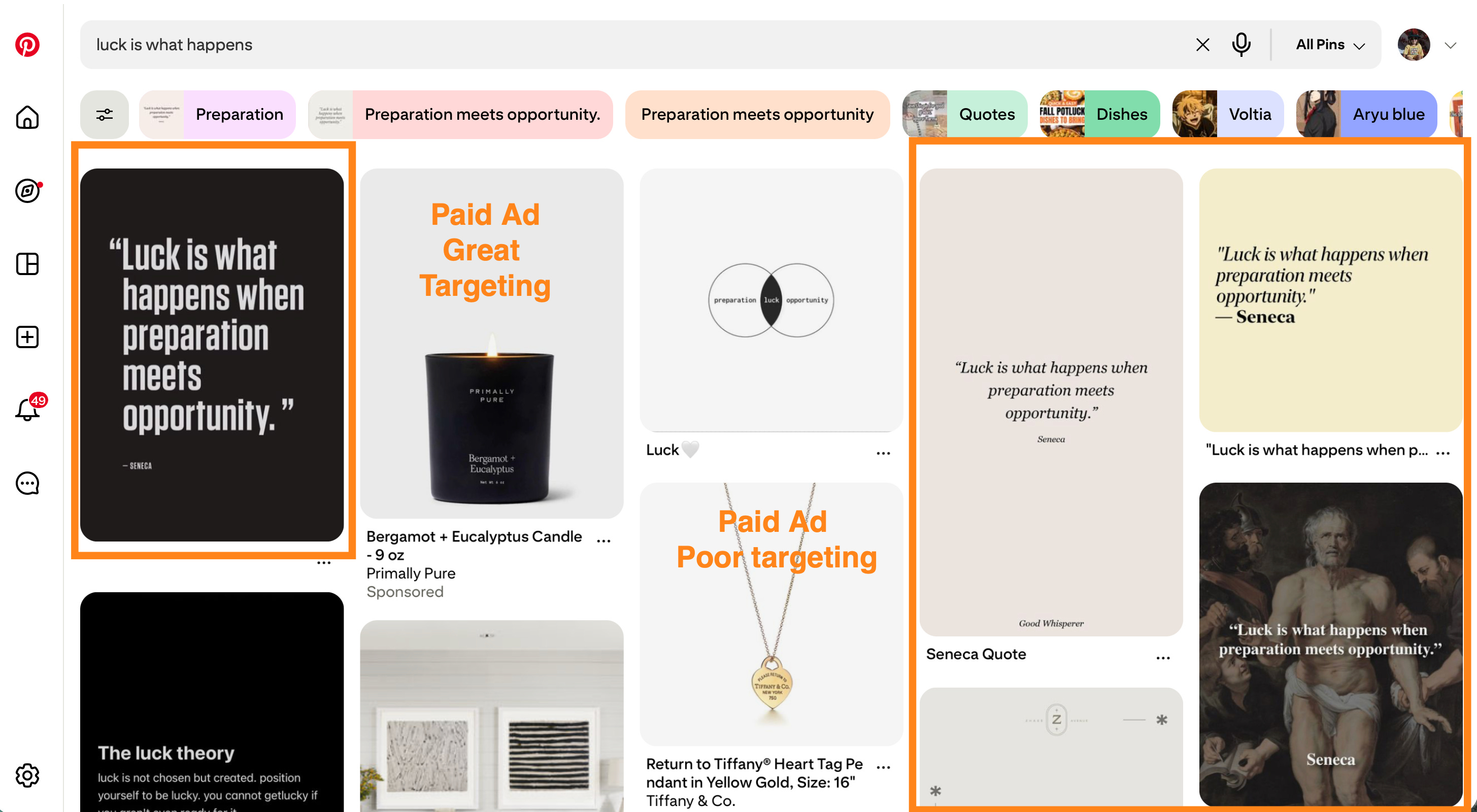
Somewhere, probably on Pinterest, pinned 8 billion times, is a quote about how “luck is what happens when preparation meets opportunity.” Eye-roll, sure. But also—
YES.
Because the moment a new job crosses your mind, it's time to blow the dust off that sad, neglected thing you call a resume and give it some New Year’s life.
If you’re new here, this is part 5 in a series:
It’s Not the Market, It’s You (and Also the Market) — on what to do when everything feels broken
Do You Really Want to Work in Tech? — on choosing a path that’s actually yours
Stop Applying to Jobs Like a Desperate College Grad — the structure that makes a job search manageable
Where Are You Actually Trying to Go? — on setting goals, near and far, and how to actually achieve them
Now back to business.
“But I heard people don’t look at resumes anymore.” - You
You’re wrong. I’m sorry, but you are. As of December 2025, yes, right now, resumes still very much matter for the kinds of roles you’re probably looking at (the ones posted online, I mean).
Are there exceptions? OF COURSE.
There are literally always exceptions to everything.
The thing to remember is that for most of us: we are not the exception.
I learned this first from He’s Just Not That Into You*, a fabulous and truly under-appreciated RomCom where Justin Long SHINES and Bradley Cooper is the absolute worst.
But anyways, think about it: I don’t know you. If you want to join my team, how am I supposed to understand anything about you without a quick summary about what you have done? Sure, if you happen to be the exception— congrats! That’s incredible. Lucky you. But for everyone else, it’s safe to assume you’re the rule**.
And there’s no better time than literally today to get on this shit…because luck is what happens when blah blah your resume is updated.

Let’s walk through what luck might actually look like in reality.
You’re home for the holiday and maybe you’re about to meet someone who could change your whole career. Maybe it’s an old mentor at the coffee shop. Or a former colleague at friend’s New Year’s party. Or a friend’s mom picking up last-minute ribbon at Target. You bump into each other, chat for a few minutes, and then, like it’s nothing, they say:
“Hey, you should send me your resume.”
You need to do this in a timely fashion.
While they still care.
Before the holidays overtake them and they return to the rush of bullshit emails after the New Year.
But all you have is that version. The one from before ChatGPT. Before your last promotion. Before you had any real sense of direction or confidence in where you’re heading.
That version doesn’t get to represent you. She barely knew what she was doing.

Okay, so how do I start?
Let’s break this Very Big Task into smaller steps.
Step 1: Gather the ingredients (your old resumes)
Deep in your iCloud Drive (or Dropbox, or “Random Docs” folder), you have at least 10 versions of your old resume. Find it.
Step 2: Open up a brand new document. A blank one.
You’re going to start fresh. You shouldn’t be dropping anything into this new document that isn’t an improved, updated version of what you had before.
“But why in this ugly Google Doc?” - You
Cementing the content is more important than final format right now. If you put the formatting first, you may sacrifice content for the sake of what’s pretty and you simply can’t be doing that. You’ll be evolving this text a lot and the frustration that may come when doing that in your beautiful document is not worth it. Formatting for beauty comes later.

So what should it generally look like?
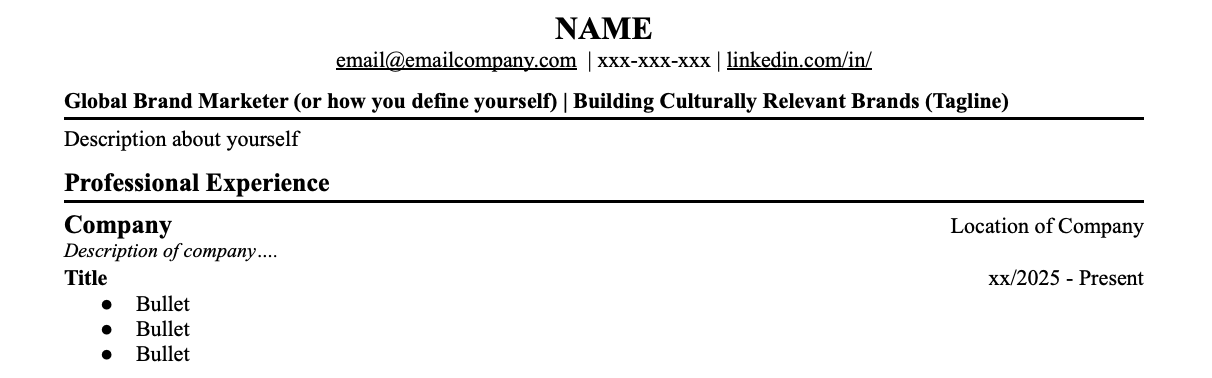
Since it’s just a Google doc (or I guess, if desperate, Microsoft word), it should look something like this to start.
The Top
Step 3: Add your contact information.
Make sure to include the critical contact items. Recruiting is probably not going to find you on Snapchat so you need to provide those old school ways us Millennials reach out to one another. If you have a shitty email, please, for the love of God, replace sugarnspice1996 with a real email address.
Yes, you needed a LinkedIn, too. It sucks, but the lack of boundaries the internet has created have us wired to want to know who we’re hiring by face now.
The Defining Statements
Step 4: Add your headlines.
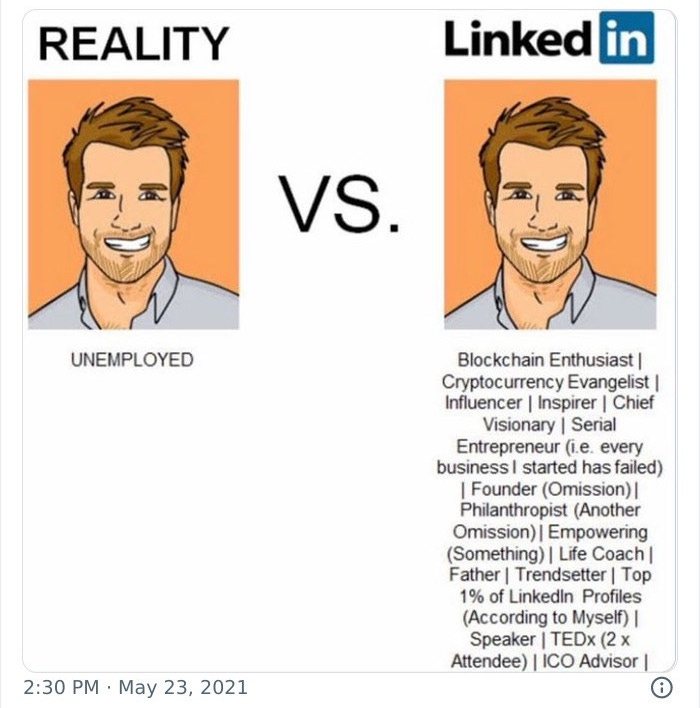
Below that critical info you’ll want to include who you are in a career sense. Are you a Global Brand Marketer? A Data-Driven UX Designer? A Social Media Strategist? A Senior Technical Product Manager? An Award-Winning Creative Director?
You want someone to glance at it and immediately get what you do. Think crisp, confident, and specific.
And next to that, you’ll want a more expansive line that describes what you’ve done. Not too much bullshit jargon here, but it’s a fine line.
Something like:
Leading hiring and onboarding to build strong, capable teams
Designing user-first digital experience
Building culturally relevant brands
Blah, Blah Blah, you’re important, we know.
The About You Description
Step 5: Write your elevator pitch.
This is your short, sharp intro: 2–4 sentences that say who you are, what you’re great at, and what you care about.

Again, where possible, skip the overabundance of buzzwords.
Think:
Marketing leader with 8+ years building global campaigns through…
Track record of coordinating and delivering high-impact analyses for global policy institutions and Fortune 500 clients, including…
But for now, don’t overthink this too much, you can always go back and refine after you finish your professional experience section.
Let’s move on to the meat…
The Professional Experience Section
Most people find this to be the most challenging part of a resume, so let’s review:
A few rules before you start:
Overall Format: Your "meaty” sections should focus on your most recent roles, especially your the last two, even if they were at the same company— and if that’s the case, break them out as separate roles under the same company headline. But everyone’s resume will look a little different and you need to consider your experience as a whole. If you were at your most recent company for just a year, that section should be concise, while a role you held for a decade deserves more detail.

Internships/Lots of Roles: If you’ve had a lot of roles but want to include internships or previous roles, save those for a later section.
Company specific language: Stop using company specific language unless you are applying for a role at the same company. I recently reviewed a resume from someone at Meta and had no idea what they were saying because they used so much internal language that only applies to Meta. It doesn’t sound cool, it’s annoying.
Two Pages: If you’ve had three to four jobs, your resume should be two pages. I really just think most resumes these days should be two pages. I don’t know why people get oddly precious about keeping it to one when it’s just not realistic for the times.
Using ChatGPT: Hate to say it but yes, you’ll likely want to use ChatGPT, Claude or a similar service because everyone else is and for those who use them well there resume results are great. I say this with a huge caveat: AI should not be doing the bulk of your writing here (OR EVER***). It should act as your partner in helping you figure out the best way to position your work that is both accurate and flattering. You need a good foundation of material for it to iterate on and use it to help you think of different ways to go deeper or phrase things to avoid repetition. It is VERY EASY for seasoned resumes readers like me to determine which resumes relied to heavily on AI, because they come out as very similar slop. And almost no one I know is good enough at Prompt Engineering to avoid this.
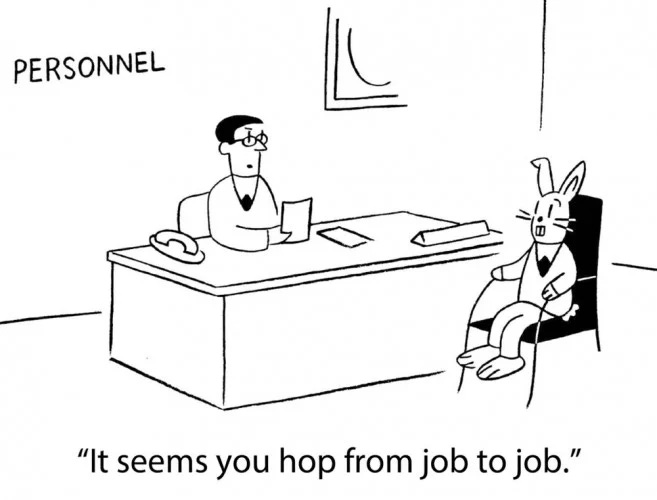
Short Tenures: It’s hard to ignore when someone has spent less than a year at several jobs, but it’s becoming more common. But just because something is more common, does not mean it’s desirable. I often hear early-career professionals frustrated that companies aren’t investing in young talent. With high turnover, though, it’s easy to see why employers are hesitant. It’s a risk. So is hiring someone who changes jobs frequently. Many younger workers don’t feel they owe a company much, which is fair. But companies don’t owe much back either. And recruiters don’t need to consider you if you can’t demonstrate a long tenure at a company. So, if you’re frequently changing jobs, consider whether your expectations, or your tolerance for workplace realities, might be part of the issue. Stability matters. If your resume is full of short stints, staying longer in your current role can help rebuild your foundation. Aim for at least two years.
Should I just quit: I’ve mentioned this before, in previous articles, but my general recommendation is do not quit while looking for a job. YES, it’s harder. But you’re just a less desirable candidate if you are intentionally unemployed and not part of a massive layoff (which is a different story).
With ALL that in mind
Step 6: Add each of your previous roles.
Company: Include a short description underneath if it’s not a household name. One sentence is plenty, but make it strong. Here’s an example for Dove Chocolates.
Weak description:
Dove Chocolate is a U.S. chocolate brand owned by Mars, known for its smooth milk and dark chocolate treats sold globally.Strong description (impact‑focused):
Global confectionery leader with roughly $50 billion in annual revenue, where Dove’s premium chocolate products contribute to the company’s worldwide portfolio across dozens of markets.
Title: Your official title goes here. If it changed during your time at the company, list each separately.
Location: City or “Remote” works fine.
Dates: Month/Year – Present (or when you left)
The First Role
Step 7: Add the main content for your most recent role.
For the experience section of your resume, aim for 5–6 bullet points for your most recent roles and around 3 for earlier positions.
Some general rules:
Each bullet should reflect how your work contributed to the broader business, not just your immediate team. This is just easier for people to visualize.
Every bullet should include a result or measurable impact.
Use numbers wherever possible, but keep them accessible—your reader shouldn’t need insider knowledge to understand your value.
Feel free to use past resumes or job descriptions to jog your memory (no shame, pregnancy has absolutely wiped mine), but be sure to update based on the above recommendations.
So instead of: Worked on a seasonal marketing plan for Dove Chocolate and supported internal presentations.
Say: Launched the first Spring promotional strategy for Dove Chocolate, establishing a new seasonal sales window projected to generate $25M in incremental revenue by 2029; pitched the strategy and execution plan to executive leadership, securing cross-functional buy-in and budget allocation.
This shows:
Clear ownership of the initiative, rather than passive involvement
Strategic thinking by identifying and launching a new sales opportunity
Quantifiable business impact with projected revenue gains — you don’t have to just take credit for what you did but it will impact things long term or has since your absence!
Executive-level communication and influence
Leadership in aligning cross-functional teams and securing resources, ability to drive a project forward with tons of people and teams involved
The Rest
Step 8: Fill out the main content for the rest of your roles.
If your responsibilities stayed the same across roles with no increase in scope or accountability, that’s somewhat concerning, so make sure your bullets show variety across roles. Even if you did similar work in multiple jobs, don’t repeat the same description. Instead, highlight different aspects of your experience and growth, ownership, and range.
A Note on Experience: Men, Women, and the Resume Problem
After reading thousands of resumes, one thing is painfully clear:
Men oversell. Women undersell.
So if you’re someone who dramatically inflates, please know we can very often tell. Listing yourself as CEO of a two-person project in college doesn’t make you a legit CEO. If you’re 24 and say you were a Senior Director, I’m going to have some serious questions. No one thinks interns launch products alone, and no one believes you had a full-time job at a real company while also in college (guys, we see the overlapping dates, just say you were an intern). People who are reviewing your resume have likely actually launched things, they read through the lines. We know what that takes. So don’t lie. It’s obvious, and it makes us trust you less and often think everything you say is untrue. Being authentic and honest is an extremely attractive quality in a hire, don’t rob yourself of that right out the gate.
Now, if you’re someone who downplays (often women) you’re probably not giving yourself enough credit. If you were the Product Manager on a product that launched, guess what? You didn’t just help. You ran the show. You made it happen. Say that. Own it.
You’re not being arrogant, you’re being honest.
Work Experience, Continued
Step 9: Add any additional work experience.
As I mentioned, many people today have been building experience from a very early point in their careers. With internships, freelance work, and part-time roles, they often have more relevant experience than they can fit on a standard resume. If you have older roles that are still worth including, consider adding a “Work Experience Continued” section and list each job as a bullet with a brief, one-line description. This keeps your resume focused while still showcasing the depth of your background.
Education
Step 10: Include all relevant education.
Educational sections haven’t changed much over the years. Here’s an example of what a strong education section looks like:
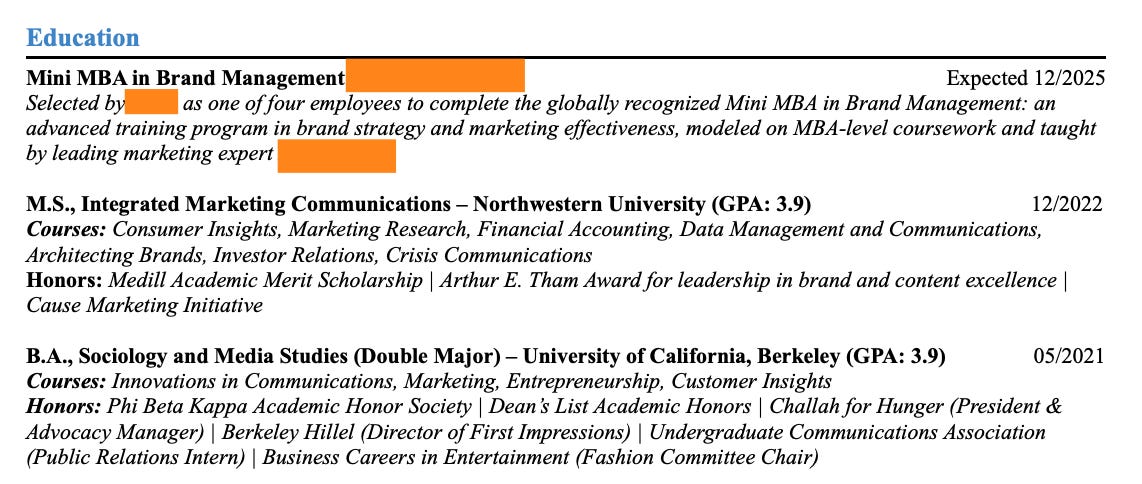
This works because it highlights recent and advanced programs first, includes selective coursework to show focus, and features honors and leadership roles that add depth. The formatting is clean, GPAs are included where strong, and everything is easy to scan. That’s truly all you need to win at this section.
Supplemental
Step 11: Include… whatever else?
Most of your background should be included under Experience (whether paid or unpaid, they don’t need to know that your Board position, consulting, etc is free) or Education. If you have something that truly doesn't fit into either of those sections, you can add a Supplemental section. This should follow a similar format to your experience section and include any additional details worth highlighting. That said, try to keep most of your content within the main two sections. To be honest, it's hard to think of many things that wouldn't belong in either Experience or Education.
Skills
I strongly encourage people to include a couple additional sections in their resume such as:
Professional Skills
Step 12: Add your professional skills.
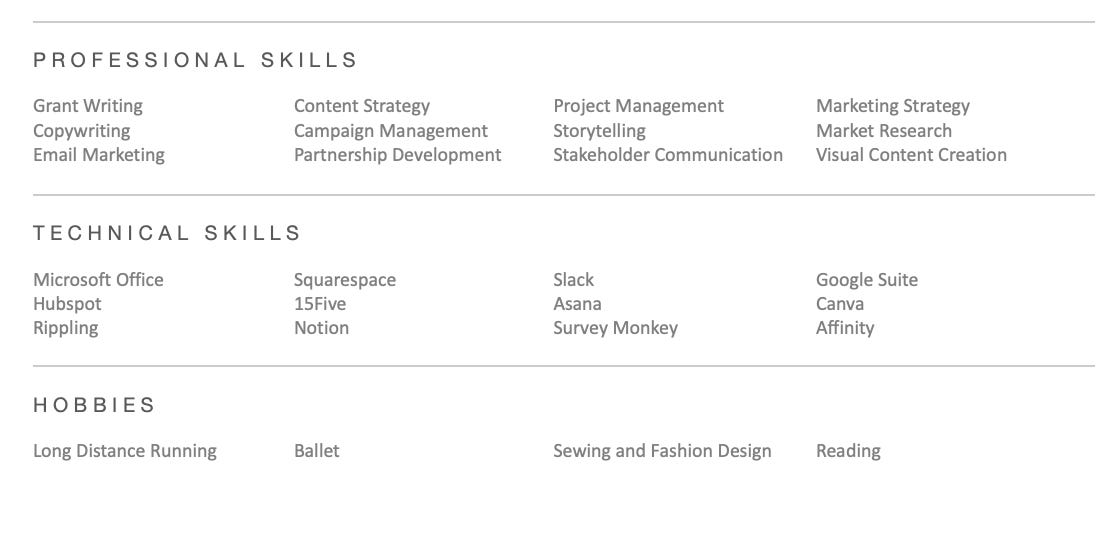
This section highlights high-level, transferable skills. Skills like Content Strategy, Project Management, and Stakeholder Communication signal leadership and cross-functional collaboration, while Grant Writing and Email Marketing show tactical expertise.
Technical Skills
Step 13: Add your technical skills.
This section focuses on tools and platforms you’re familiar with. These are often listed in job descriptions and can help with applicant tracking system (ATS) keyword matches. It includes workplace staples like Microsoft Office and Google Suite, along with industry-specific tools like Canva, Slack, and Hubspot. It also shows some familiarity with platforms related to employee engagement (15Five, Rippling) and productivity (Notion, Asana). Onboarding people onto these platforms take time, and can make a huge difference in whether someone wants to hire you for junior positions. If you need to beef up this section, take some online courses. They’re easy, and give you enough to claim to you know it.
Hobbies
Step 14: Don’t forget some fun.
You definitely don’t need this section, and a lot of people will say NO DON’T INCLUDE THIS. But if you ant to end up on a team that actually fits you, I think a section like this really makes you stand out. This personalizes your resume and gives a glimpse into who you are outside of work. Including Long Distance Running, Ballet, Pottery, Sewing, and Bird Watching adds dimension and makes you more relatable. It also may give you an advantage if your hiring manger connects with you on these same areas.
That said, this isn’t the place for subtle bragging. No one needs to hear about your love of yachting unless you are an actual competitive yacht person. (Do those exist? I’m not looking it up.)

Final Formatting
Step 15: Find a final format.
Okay, you’re almost done. Finally. That was a lot of work.
Writing this was exhausting, so I can only imagine how it felt to actually doing what I said to do.
Now, once you’ve gone through a few rounds of edits, it’s time to focus on presentation. This isn’t necessary for every role. For example, most engineering positions don’t require a visually polished resume. But if you’re in marketing, design, or another creative field, having a clean, well-designed layout can help you stand out.
I usually recommend browsing Etsy for resume templates, but avoid anything that’s too bold or overly colorful. A clean, simple design is the best choice. What looks stylish to you might come across as distracting or unprofessional to someone reviewing your resume.
Here are a few I recommend:
Adjusting Resumes for Different Roles
Step 16: Make a few different versions.
Once you have a strong base resume, the truly final step is tailoring it. You don’t need to rewrite your entire resume every time you apply for a job, but where appropriate, you may want to make adjustments when applying for competitive roles.
Start by reading the job description closely. What are they actually asking for? What keywords keep coming up? Then, look at your resume and ask: Is it obvious that I can do this job? If the answer is even slightly no, tweak it.
Here’s what “adjusting” might look like:
Reordering bullet points to lead with the most relevant experience
Swapping in different verbs or language to match the job description (without copying it word-for-word)
Adding or removing certain bullets depending on what the role emphasizes (for example, more strategy vs. more execution)
Renaming sections if needed (e.g., changing “Projects” to “Freelance Work”)
A tailored resume shows that you understand the work they need done.
And yes, this takes time. But it can be the difference between getting ignored and getting the interview.
Oh my God, You’re Still Here
Look at you. Still here. God, I’m shocked I’m still here.
But now you’ve got something real to work with that sounds like you and makes it clear what you actually bring to the table.
You don’t have to love it yet, you just have to have it. That alone puts you ahead of more people than you think.
Now, when someone says, “Send me your resume,” you’ll be ready.
And with that, go do something that doesn’t involve bullet points.
You’ve earned it (and so have I).
Digital Tip Jar 💸
I’ll never make you pay to read my thoughts on career stuff. This knowledge should be available to everyone. But your girl still has bills, and since Substack doesn’t offer a tip jar yet, feel free to send whatever you think it’s worth HERE. If you think it’s worthless, send me a request for money and I’ll promptly ignore it, because f*ck off.
And, oh yah, subscribe if you can’t afford a coach.
Because there Is So Much More Coming.

*Incredible movie, so much still applies today.
**Unless this is a nepotism hire, which, sadly, is a lot of hires. Or someone I’ve already hired once, which is basically the same thing, just with less guilt.
***As of December 2025, it’s just not there yet. Also, for the love of God, writing is not that horrible. It can even be, dare I say, kind of delightful.