

On Mistakes
& Spiraling


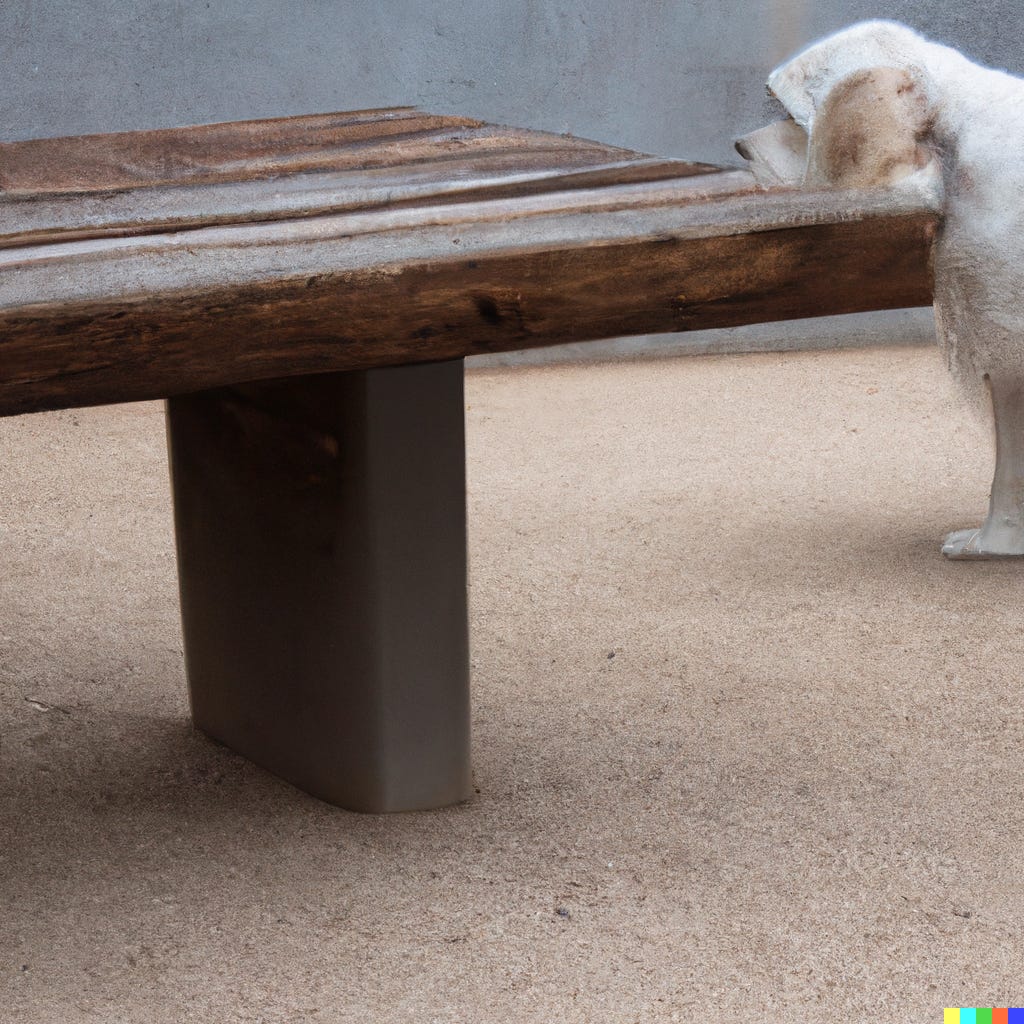
A few weeks ago, my charming yet oblivious canine accidentally tore up the surface of a gorgeous wooden bench. To be honest, I wasn’t entirely sure he was to blame, but due to my ingrained Catholic guilt, I automatically assumed fault. In the scheme of life, this was NBD, but the real problem was the bench wasn’t mine.
A rational individual might assess the situation, respond with a fitting level of concern (mild, at most), and come to terms with the fact that accidents can and do happen.
They might even choose to leave it as is and assume (probably accurately) that the owners wouldn’t notice. Scratches, nicks, etc., add character.
But I wasn’t having a rational day.
Panic set in as I felt the weight of a mistake. I rushed into town. At the hardware store, a young girl, probably no older than nine (I wish this was a joke, but nope), rang me up for a sanding block and clear finish I purchased to buff and seal the damage. Her oversized glasses slid down her tiny button nose as she surveyed my purchases skeptically.

Back at our Airbnb, it became clear that instead of repairing the scratches as intended, my concentrated sanding worsened the aesthetic. There was now a noticeable discoloration.
On my second trip to the store, I purchased a wood stain. The little Doogie Hauser of hardware rang me up, shaking her head slightly, her silver butterfly necklace swaying from her neck.
An hour later, after failing to match the spot to the surrounding color, I admitted defeat.
For a third time, borderline hysterical, I returned to Hardware Elementary School. Standing on her stepping stool, the child pointed over the register to the aisle with the sanders. Her enormous eyeballs lingered on me— clearly sensing my potent vibe of failure.
Five hours on, one entirely sanded bench and several coats of stain later, the bench looked better than it did initially.
In fact, on the outside, it looked great.
But on the inside—my inside— I was drained. Within those same five hours, I had lost not only my dignity to a 9-year-old but also my inherent ability to compartmentalize and put this problem into proper perspective.
In sum, I had lost my sanity.
Tunnel Vision
Often, when situations unravel, it all starts with a tiny mistake.
But in that moment, it doesn’t always feel tiny, does it?
It feels big. It can feel blinding. As a result—
We obsess.
Our fixating gives this once miniscule problem a disproportional amount of attention and importance.
And then it snowballs.
We develop a sense of urgency around solving the problem because we (inaccurately) believe that others care far more about it than they do.
This sense of urgency can hamper our ability to see the bigger picture and make us vulnerable to quick, ineffective fixes that address the present problem but lead to more significant, enduring challenges down the line.

How To Stop Spiraling
Tunnel vision can be a good thing at times. There are moments in life when we need to singularly focus without distraction. But there are many more moments, like my blunder with the bench, when we don’t realize we’re in the tunnel, and our ability to make rational decisions is compromised.
Soon, we find ourselves trapped by the repercussions of our mistakes and, ultimately, overwhelmed with the consequences.
So how do you make it stop?
STEP 1: AWARENESS
The first, and often the most challenging step, is awareness—recognize when you’re fixating. For me, spiraling starts when I feel the sudden urge to take action, when my heart is beating faster than usual, and I can’t progress with my everyday responsibilities without immense mental effort.
For others, it can present as catastrophizing — assuming the worst.
Or, in its more gentle form, tunnel vision can feel like unnecessary pressure we put on ourselves to resolve a situation when no one around us is telling us to.
Every individual possesses their own distinct collection of personal experiences, which means that the way anxiety manifests will vary from person to person.
Pay attention to yours and try to name it to better recognize it in the future.

STEP 2: PAUSE
When you recognize that you're spiraling, just hit that pause button.
A solid 5 to 10 minutes of pure silence can do the trick.
Try to meditate.
I know those voices won't quiet easily, and I don't expect you to clear your mind completely - you're not Ghandi.
Just give it a try.

STEP 3: PUT THE PROBLEM IN PERSPECTIVE
When you’ve had a moment to center, give the situation a reality check and ask yourself some questions.
How likely is it that the worst-case scenario you envision will come true?
Probably pretty damn small. And even if it did—
How would you handle that situation, realistically?
Most of the time, our worst-case scenarios are quite manageable; it's just our fear that magnifies their perceived unmanageability.
STEP 4: IDEATE SOLUTIONS
With the problem in perspective and your worst-case scenario addressed, return to the present. What are potential solutions?
Think of at least three solutions.
What are the short, and long-term potential outcomes of these actions?
Who might these actions impact outside yourself?
What is your actual deadline for solving this problem?
What would happen if you waited? If you did nothing?
STEP 5: DO NOTHING—yet.
And now comes the most important part —
Do nothing.
It’s time to take a break.

Go for a run, read a book, or do anything else for the next few hours to ensure that your adrenaline levels return to some semblance of normal.
For some, it might take longer. I like to take 24 hours to think over a serious decision, at a minimum.
After a while, your heartbeat steadies, your mind clears, and you can return to your previous work to address the problem rationally.
This practice can take time to perfect. And you'll have plenty of setbacks. But as you repeat this process over time, you'll notice it becomes more natural.
Eventually, you might even reach a level of—shall we say Ghandi-espque enlightenment—where calm will be your natural state when facing a storm.
At the very least, in future moments of panic, you'll learn to pause.
Look around.
And notice when you just might be—
in a tunnel.
It might even save you a few trips to the hardware store.
—
Sharing is Caring. 💌
If you know someone who could benefit from this piece or others, we greatly appreciate you forwarding to a friend!