“I applied.” (But did you, though?)
The Art of Finding a New Job, Part 6 of Many

When someone tells me they just applied for a job, my first question is always:
“What do you mean?”

It’s not quite the response they expect. They expect “How exciting!” or “Good luck!” or in a lot of cases, “Let me see if my friend can put in a good word!”
But “applying” has become a dangerously loose term in today’s world, and I’ve learned that our definition for that verb varies greatly.
For me, perspective of one, applying for a job is a comprehensive strategy, a series of intentional moves designed to get you noticed. To many, it means clicking “Easy Apply” on LinkedIn and calling it a day.
And, in my not-so-humble opinion, those many are woefully misled to think their job is done. The actual submission of an application is the bare minimum.
So in today’s piece, I’m breaking down what it actually looks like to throw your hat in the ring, and the specific steps required to ensure your candidacy actually stands out.
If you’re new to this series, I’ve written several pieces you might want to visit first before continuing:
It’s Not the Market, It’s You (and Also the Market) — on what to do when everything feels broken
Do You Really Want to Work in Tech? — on choosing a path that’s actually yours
Stop Applying to Jobs Like a Desperate College Grad — the structure that makes a job search manageable
Where Are You Actually Trying to Go? — on setting goals, near and far, and how to actually achieve them
A New Year’s Resolution: Dust off that Resume - a tactical, step-by-step process of updating your professional narrative for a competitive 2026 market
The Pillars of Applying
While every job search looks a little different, there are a few core principles that apply to almost everyone (who is applying, that is). I think of these as the four pillars of a strong application process. Together, they map the most important stages of a high impact approach to getting hired.
These can be broken down into four steps:
The Pre-Application Referral Outreach
The Application
The Post-Application Outreach
The Follow-up and Thank You’s
1. The Pre-Application Referral Outreach
This is the stage that makes people the most uncomfortable because it requires you to actually use the network you’ve (hopefully) been building.
Before you ever hit “Submit,” you need to open LinkedIn &/or contact database of some sort and see who you know—or who you are one degree away from—at that company. Most in-network employees are happy to provide a referral (especially since many companies offer a referral bonus), provided you have a solid reputation (meaning you didn’t blow it in some way).
However, a referral is an act of trust.
People might hesitate to help if:
They are new to working there there: Your performance (and your interview behavior) will reflect on them, and they may still feel their reputation is delicate.
The relationship is one-sided: You only reach out when you need a favor. This is just annoying. Stop doing this. Networking is give and take. And I find it’s always best to have a lot of people you have done favors for because you never know when you’ll need them.
The approach is presumptuous: You assume they’ll help without acknowledging the favor you’re asking. Even if they are your friend, or you have done them a favor, you are still asking them for a favor.
They are selfish: Some people just are. Don’t take it personally. But don't feel obligated to extend yourself for them in the future.
For the sake of length of this piece, I’m going to assume you’ve done the legwork:
You are in good standing with your network
You’ve offered help in the past, and;
You’re approaching this with the right etiquette.
With that in mind, if you have a direct connection at said company, here is a rough template you can adapt to ask for that referral:
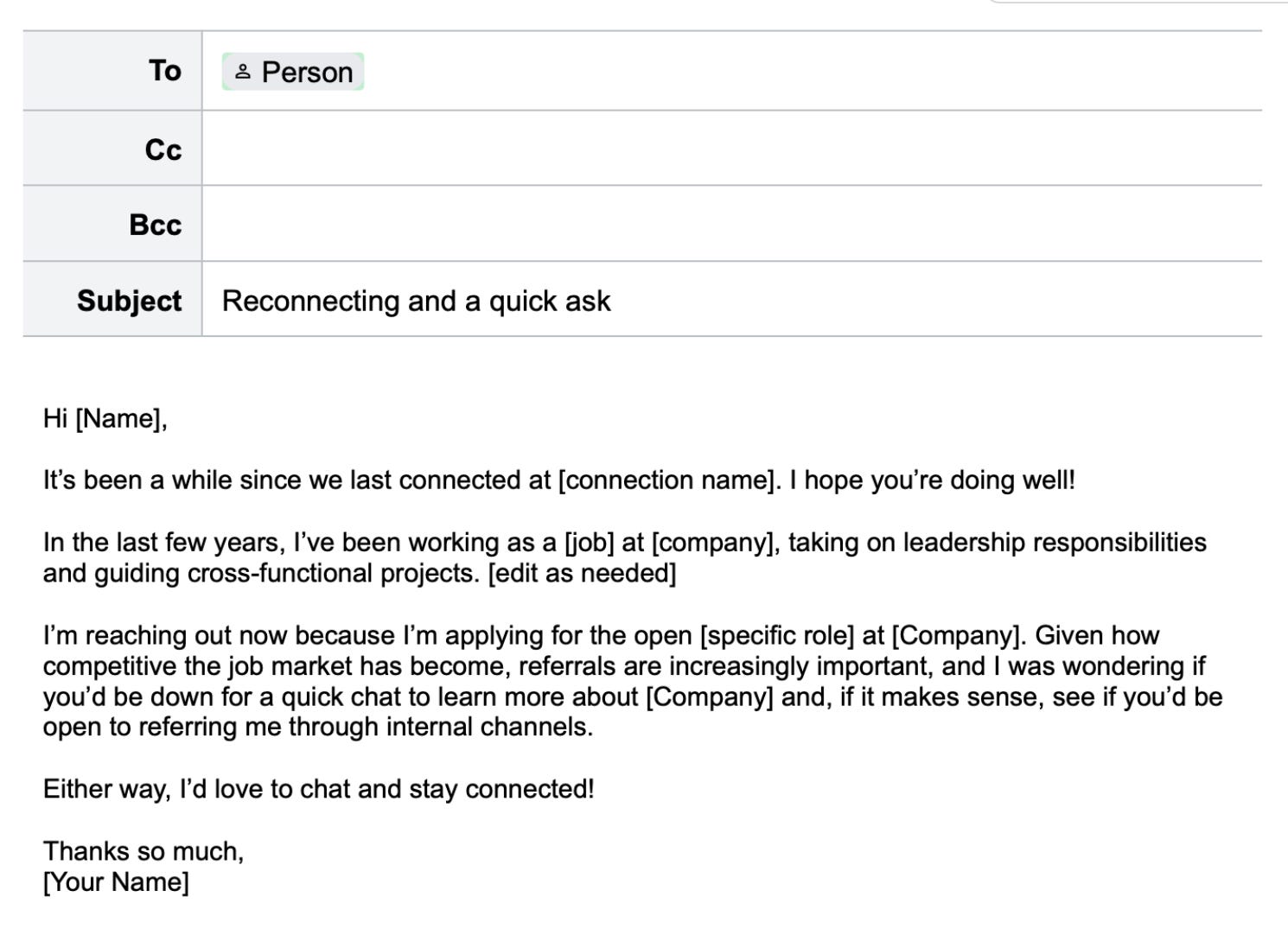
Now if you’re asking for a referral from their connection, you can adapt to:
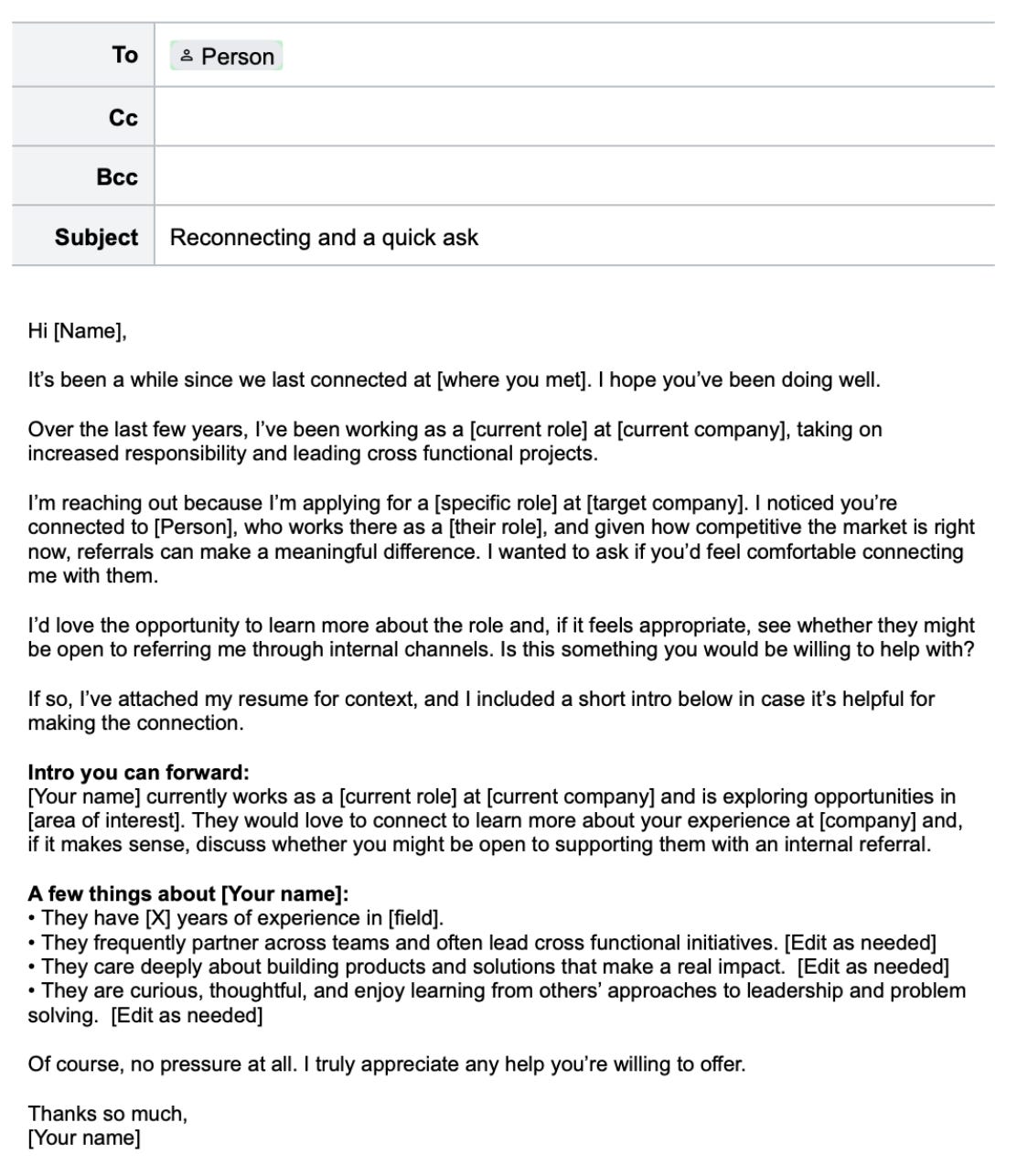
When it comes to referrals, I usually recommend waiting just a few days for a response before moving forward and applying directly. Hiring timelines can move quickly, and you don’t want to miss your window if the team has already made significant progress with other candidates.
So let’s get to it.
2. The Application
What you should not do when applying:
Quick apply and leave it.
What you should be doing when you apply:
Make sure your resume is the resume you really want to be seen. I wrote a whole piece about writing your resume here.
Tailor your resume to the role. Use keywords from the job description and adjust your language so it accurately reflects your experience while aligning closely with what the team is looking for.
Be intentional about how you position your background. Lead with the work that is most relevant to this role, even if it means dialing back impressive but less applicable accomplishments.
Include any additional materials requested, such as portfolios, updated LinkedIn links, or examples of work. This can also include press coverage, product launches, or projects you contributed to that show real impact.
Customize your cover letter or intro message if the application allows it. Use it to clearly connect your experience to the role and explain why this team specifically makes sense for you.
Double check your online presence. Make sure your resume, LinkedIn, and portfolio all tell the same story so your narrative feels consistent everywhere a recruiter might look. Note: This is also why I don’t like people to put their job descriptions in depth in their LinkedIn or their resume, as it should change just slightly for each role.
Apply quickly. Teams often move fast, and you don’t want to risk waiting too long if they are already deep in the process with other candidates.
Track where and when you apply. Keep a simple list of roles, dates, and contacts, and resumes/cover letters you submitted, so you can follow up thoughtfully later.
Have a follow up plan before you hit submit. Know who you might reach out to post application and what you will say, so momentum does not stop once the application is in.
While this feels like a heavy lift now, repetition will eventually make it second nature. I recommend applying to one role per day to build the habit, even for jobs that aren't your top choice. At worst, you’ll get the practice you need for this market; at best, you might discover a company you didn’t realize was a fit.
And when you’ve done all that…
3. The Post-Application Outreach
This part is new for a lot of people. Even if they have the referral request down, and do a stellar part on their actual application, when you're competing against thousands of others, being 'qualified' doesn't guarantee eyes on your resume. Because so are most people applying.
You have to move beyond just applying and focus on how to actually get noticed within that bottomless pit of candidates.
The secret to getting noticed isn't the submit button; it’s the follow-up. Wait no more than 24 hours for your data to settle in the system, then trigger a 'Second Wave' outreach to force a human set of eyes onto your resume.
The Rule of Three: Who to Contact
Don’t put all your eggs in one basket. You want to reach out to at least three people to maximize your chances of a response:
The “Loose Connection”: Someone you may know (even if not well) or a 2nd-degree connection. Even if you didn’t feel comfortable asking them for a referral initially, this is the time to mention you’ve applied, and see if they may flag your resume or put in a good word.
The Peers: 1-2 people you think are currently on the team you’re applying to. These are your potential future colleagues.
The Gatekeepers: 1–2 recruiters who specialize in that department (e.g., “Technical Recruiter” or “Marketing Talent Acquisition”).
How to Find Them
Use LinkedIn’s search filters to narrow the field:
For Peers: Search the [Company Name] + [Job Function]. Look for people with titles similar to the one you applied for. Check their “Activity” tab to see if they’ve posted about the role or the team’s recent wins.
For Recruiters: Search [Company Name] + “Recruiter.” You can further filter by “People” and “Location” or use keywords like “University Recruiting” or “Product Design Talent.”
The Outreach: Lead with Value
The biggest mistake is asking, “Did you see my resume?” That creates work for them.
Instead, use The Value Angle.
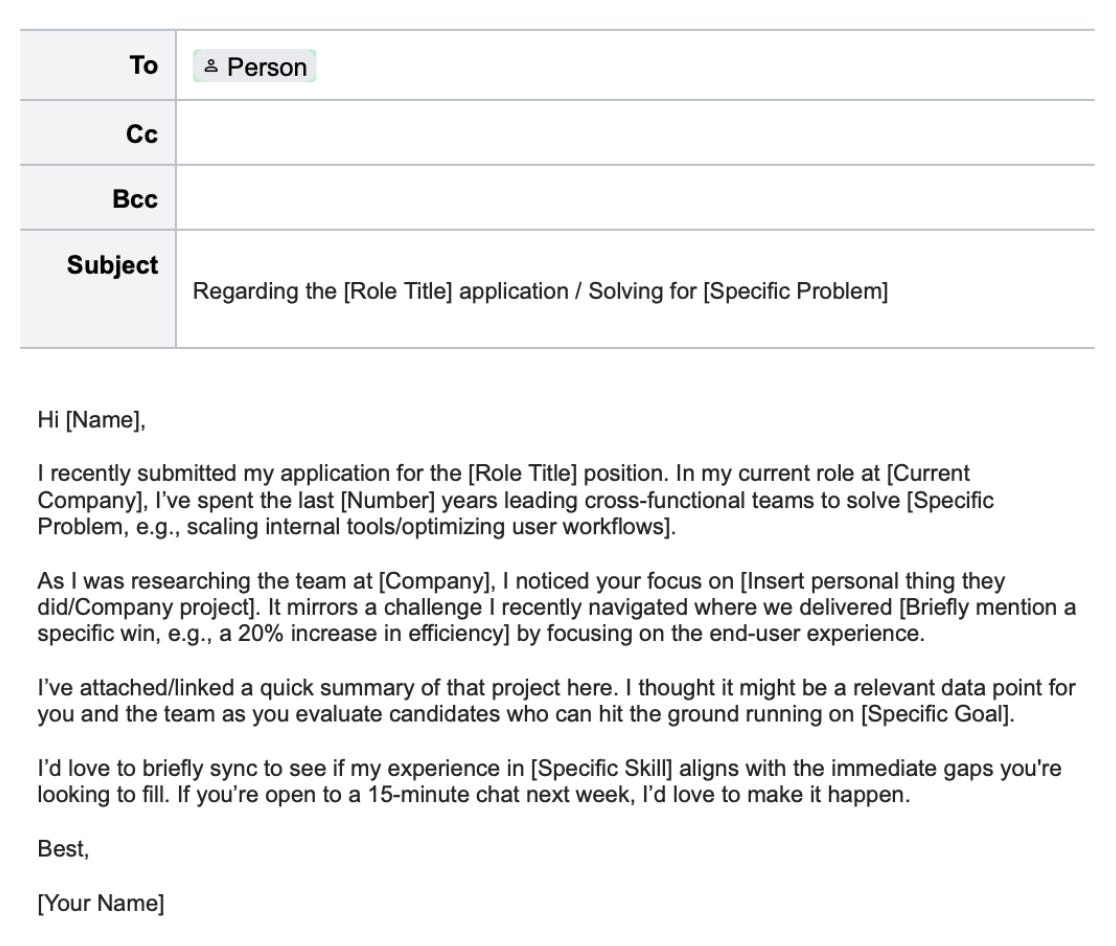
By providing your value rather than just asking for a favor, you give them a compelling reason to dig your resume out of the pile because you’ve already proven you can solve their current headaches. This strategy creates a "surround sound" effect so that by the time the hiring manager checks their inbox, they’ve received your note, maybe a ping from a recruiter and/or a mention from a teammate, effectively moving your application from the "bottomless pit" to the top of the "must-interview" stack.
Which leaves the final step…
4. Follow-up and Thank You’s
Most people send one message, get met with silence, and assume the answer is “no.”
In reality, the person on the other end is likely just busy. They have back-to-back meetings, a toddler at home, or an inbox that keeps repopulating at unncessary speed. When you don’t follow up, you are letting your application die in their “I’ll get to this later” pile.
The goal of the follow-up is to be “pleasantly persistent.” You aren’t demanding a response; you are providing a helpful reminder. If you haven’t heard back within five business days, I absolutely recommend sending a “Bump.”

The “Bump” Protocol:
Keep it in the same thread: Don’t start a new email. Reply to your original message so they can see the context immediately.
But feel free to change the subject line, just slightly: Consider adding 'Follow-Up' to the subject line as a subtle nudge. It signals that this is a continued thread, which can prompt them to look for the initial message they might have missed.
Be brief: They already have the info. You are just surfacing it.
Remove the guilt: Use phrases like “I know things are busy on your end” to lower the social pressure.
The “Bump” Template:
This version will have so many variations that it’s not even worth screenshotting a template example, just keep the below tone/structure in mind.
“Hi [Name],
I’m surfacing this at the top of your inbox in case it slipped through the cracks during a busy week. I’m still very interested in the [Role] and would love to [be referred / connect with the team].
If you’re able to help, I’ve re-attached my resume for easy access!”
Thanks again,
[Name]
Closing the Loop
If they do respond or submit that referral, the process isn’t over. You send a thank you immediately. Not because of “etiquette,” but because you are building a professional bridge.
If you get the job, this person is now your colleague. If you don’t, they are still a permanent part of your network, and that’s a beautiful thing.
The New Standard
The next time someone asks if you’ve applied for a job, I want you to look at these four pillars.
Unless you have a referral, a tailored resume, and a plan for outreach and follow-up, you haven’t applied for a role—you’ve simply added your name to a list of hundreds.
Today’s job market doesn't favor the high-volume applicant; it favors the strategic one.
While this approach requires more effort for every single application, it is the only reliable method for moving your resume from an automated system onto a recruiter’s shortlist.
Now, go check your sent folder. It’s time to send those follow-ups.
And, oh yah, subscribe if you can’t afford a coach.
Because there Is So Much More Coming.