

Your Obsession with FAANG Bites
The Art of Finding a New Job, Part 7 of Many

GOD. I know. The hypocrisy is blinding.
Here I am, shouting 'Don't do it!' from inside the house, collecting my Faangcheck bi-weekly, handing out my friends & family discount like Halloween candy.
But I’m writing this because you should do as I say, not as I do. I didn’t apply to work at Apple, we were acquired.
That’s just how the acquisition math worked out.
But the math on applying to jobs is unbiased, and very different.
When you factor in shrinking headcount, internal shuffling often filling available headcount, and the sheer volume of applicants per role, you are statistically more likely to get your resume seen literally anywhere else than at one of these massive companies you have your eye on.

And while you’re at it, the same applies to these new babies.

But the good news is there are amazing companies doing cool shit that you’ve never heard of.
This piece is about how to find them.
But first, if you’re new to this series, I’ve written several pieces you might want to visit first before continuing:
It’s Not the Market, It’s You (and Also the Market) — on what to do when everything feels broken
Do You Really Want to Work in Tech? — on choosing a path that’s actually yours
Stop Applying to Jobs Like a Desperate College Grad — the structure that makes a job search manageable
Where Are You Actually Trying to Go? — on setting goals, near and far, and how to actually achieve them
A New Year’s Resolution: Dust off that Resume - a tactical, step-by-step process of updating your professional narrative for a competitive 2026 market
“I applied.” (But did you, though?) — a deep dive into the four-pillar strategy required to move a candidacy from a digital pile to a recruiter’s shortlist.
Now let’s get back to how to find your new employer.
Search Tactics #1: Use Chatbots Effectively
Look, I get it. We spent all of 2025 complaining that AI is ruining the recruitment process (and it is). It’s flooding inboxes with spam applications and letting recruiters screen you out with zero human empathy. But if you’re going to survive this market, you have to stop bringing a knife to an algorithm fight.

The superpower of LLMs (Chatbots like ChatGPT, Claude, or Gemini) isn’t just helping improve your resume and cover letter, it’s discovery.
Most job seekers have a “mental roledex” of about 20 companies, but sadly, they are usually the same 20 companies everyone else is applying to (FAANG + big AI Companies+probably Airbnb or something).
This is exactly why you’re competing against 5,000 applicants per role, wondering why you can’t even get a rejection email.
If you’re already in that inner circle, sure, you can network your way around. But for everyone else, or for anyone not already in the bite radius of FAANG, you need a new target list. You need to find the companies that haven’t become household names yet, but still have the funding, culture, and problems you want to solve.
And LLMs are here to help.
Here’s a series of prompts to get you started, and I highly encourage you to choose your own ending and work off the responses these prompts give you to go even deeper.
The “Culture Match” Prompt
Traditional job boards run on keywords (“Java,” “Marketing Manager”). AI runs on semantics (meaning and context). You can describe a culture or a mission, and it can find companies that match the culture or reputations you’re hoping to find.
Example prompt:
“I am looking for B2B SaaS companies in the healthcare space that are Series B or C funded. Please exclude the top 10 market leaders and any well-known 'unicorns' in this sector. I specifically like companies with a reputation for engineering excellence and a product-led growth model. Who fits this description but is currently flying under the radar?”
The “Little Sibling” Strategy
You know you like the culture of [Big Cool Company], but they aren’t hiring (or the line is too long). Use AI to find their smaller, hungrier competitors with decent funding.
Example prompt:
“I love the product philosophy of Notion and the design aesthetic of Airbnb. Who are smaller, lesser-known companies (under 500 employees) that share this specific design-centric ethos and have some funding? Exclude any companies that are currently trending on major tech news sites or have valuations over $1B.”
The “Problem Solver” Search
Instead of searching for a title, search for the problem you want to be paid to solve. This is how you find companies doing “cool shit” in industries you didn’t know existed (like logistics, ag-tech, or maritime law).
Example prompt:
“Make a list of technology companies that are specifically working on decarbonizing the supply chain. Prioritize companies that have raised funding in the last 18 months, but remove any industry giants or publicly traded corporations from the list. I am looking for mid-market challengers and emerging startups only.”
The “Deep Dive” (Validation)
Once you have a name, don’t just apply. Use the bot to prep your “Why us?” answer before you even open the application.
Example prompt:
“Act as a cynical industry analyst. Tell me the three biggest strategic challenges facing [Company Name] in 2026. Specifically, analyze their vulnerabilities in competing against the dominant market leaders in their space.”
But if you’re still struggling…
Search Tactic #2: Weaponize Your Inbox
If AI is for finding companies that exist, newsletters are for finding companies that are on the rise.
Most job seekers treat their inbox like a defensive line. I’m 100% guilty of hitting unsubscribe habitually. But in times like these it might be helpful to treat your inbox like a Venture Capitalist treats their “deal flow” and look for signals of momentum: Funding, Product Launches, and Ecosystem Activity.
Fortunately for you, this information is public; it’s just buried in emails you’re probably deleting.
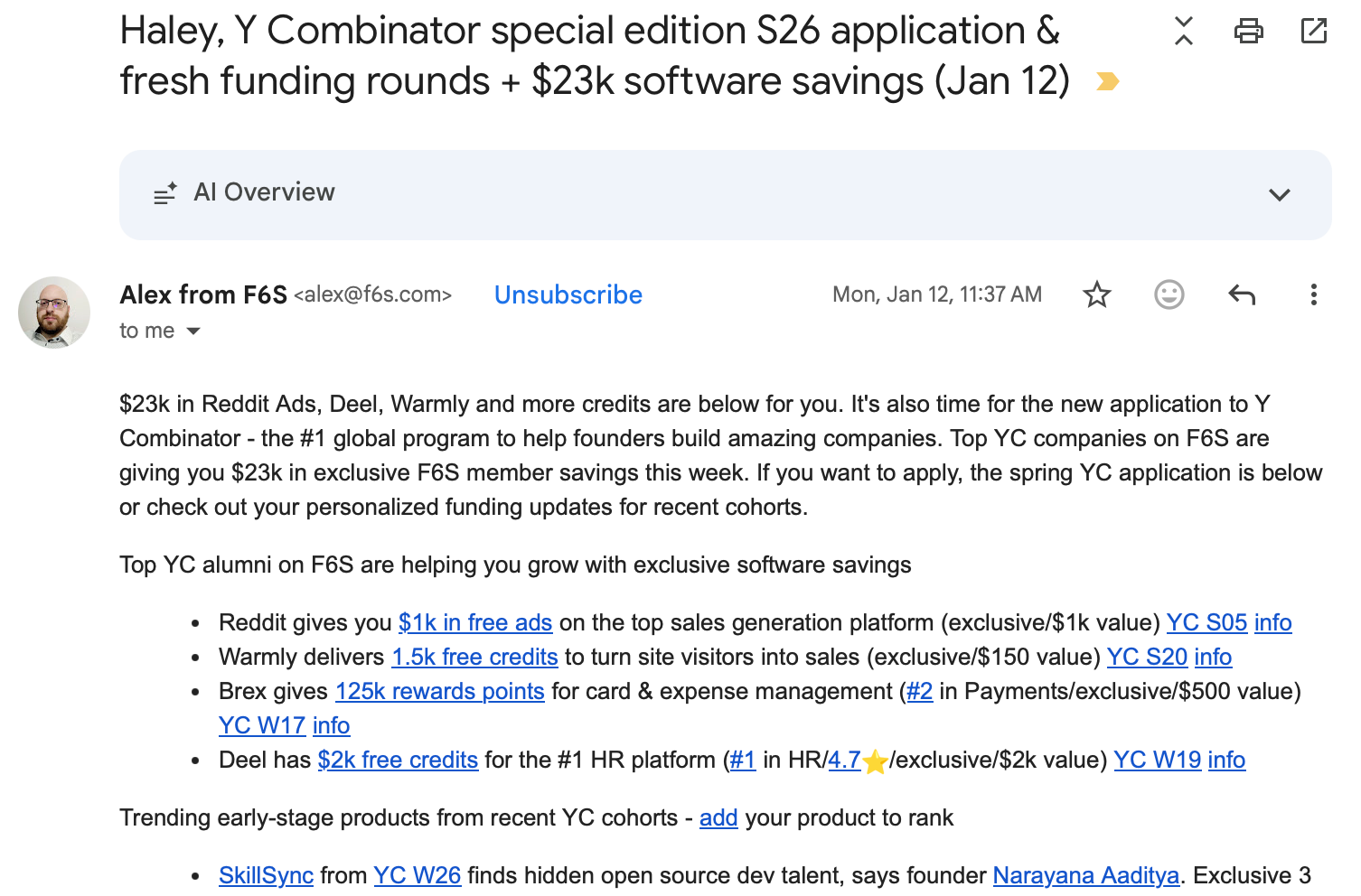
Here is how to turn your inbox into a headhunter:
Follow the Money
This is the single strongest signal in the market. When a company raises a Series A or B, two things happen immediately: they get a bank account full of cash, and their board tells them to hire 20 people yesterday.
Subscribe to newsletters like StrictlyVC, Axios’ Pro Rata, Term Sheet and F6S.
Subscribe directly to VC newsletters like the a16z Newsletter or sign up via CTAs like the in your inbox CTA at the bottom of General Catalyst’s News & Content page.
Scan the “Fundings” section. If a B2B Fintech company just raised $15M, go to their careers page. The roles won’t be on LinkedIn for another two weeks. You beat the rush by applying when the ink is still wet on the term sheet.
The Industry Play
If you’re zeroed in on a particular industry and want to stay in it, this is the way to go. A lot of people tell me they want to “work in AI.” That is basically like saying you want to work for “an App company” 15 years ago. It’s too broad to be useful. You need to find the specific rocket ships before they leave the launchpad.
Subscribe to the newsletters that obsessively curate the newest tools, like Superhuman (Zain Kahn), The Rundown, or Ben’s Bites, or whatever industry your focus might be. Substack is, of course, a great resource here too (see full list at bottom of page).
Read them to find employers. Scroll past the headlines about OpenAI and Google. Look for the “Featured Tools” or “Startup of the Week” sections or other companies that are mentioned in passing and dive deeper.
Example: If Superhuman features a new AI productivity tool you’ve never heard of, that startup just got put in front of 600,000+ potential users. They are about to get slammed with traffic and growth pains. That means they need help, your help, right now. Applying the week they get featured shows you are plugged into the ecosystem and ready to solve the problems they literally just discovered they have.
Don’t see a job? Email the co-founder or someone else who is hyped and may want to talk to someone who seems entrepreneurial for reaching out.
Don’t wait for a job description to be posted to a board where 4,000 people will see it. Go upstream. Find the news before it becomes a job posting.
Explore Other Job Boards
If LinkedIn is the “Times Square” of job hunting (loud, crowded, and full of scammers), these boards are the speakeasies. You might see fewer total listings here, but the signal-to-noise ratio is infinitely higher.
Plus, these spaces let you opt out of the 'Success Theater.' LinkedIn is designed to trigger comparison envy, often making you jealous of peers who, behind the scenes, are actually on the brink of a layoff. So let’s avoid the feed when possible, and go where the competition is quieter and no one is posting multi paragraph manifestos about how they nailed interviews at every company you ever wanted to work for — and you can too!

1. Wellfound (formerly AngelList)
This is the gold standard for the startup world. Its superpower is transparency: they force companies to list salary and equity upfront, so you aren’t guessing if a “competitive salary” means market rate or pizza parties. You can also filter by funding round (e.g., Series A vs. Seed), which helps you avoid startups that are running on fumes.
2. Y Combinator (Work at a Startup)
Think of this as the “Common App” for the Silicon Valley elite. You fill out one profile, and it becomes searchable by hundreds of YC-backed companies. It is high-expectation, but high-reward; the founders here are looking for builders, not bureaucrats.
3. Hacker News (Who’s Hiring)
It looks like a forum from 1999, but don’t let the interface fool you. The “Who is Hiring” threads are arguably the most powerful resource in tech because the posts are often written by founders and CTOs. It is a direct line to the decision-maker, and the response rate is often significantly higher than traditional boards.
4. Otta
If Tinder made a job board, this would be it. Otta is highly curated and “tech-forward,” filtering out the consulting body shops and sketchy firms to show you companies with actual culture. It’s excellent for discovering brands you’ve never heard of but would love to work for, matching you based on your preferences for culture and mission.
5. Femtech Insider
This is the blueprint for “vertical” hunting. It is the central hub for the women’s health ecosystem. If you want to work in fertility, menopause, or maternal health, this is where founders post before they go to LinkedIn. Use specialized boards like this (or Climate Draft for climate, etc.) to find mission-driven work that gets lost on the big, generalist sites.
6. We Work Remotely (WWR)
The OG of remote boards. The secret here is the paywall: companies have to pay ~$299 to post a job. That small barrier to entry eliminates 99% of the scammers, multi-level marketing schemes, and low-effort “ghost jobs” you find on free boards. If a job is listed here, the company is spending money to find you.
Main point here: Don’t just rely on the “Big Two” (LinkedIn/Indeed). Spend 20% of your time on the giants, and 80% of your time on these high-signal niche boards.
The Harder Way is the Easier Way
I’ll be the first to admit: this strategy feels harder. It requires you to be a detective, not a robot. It forces you to research, to read, and to actually give a damn about where you apply.
But you should give a damn. Doing this heavy lifting upfront saves you from the spirit-crushing rejection of the spam-cannon approach. Better yet, it puts you in position to land early equity at the next big thing (in which case, I expect a finder’s fee, naturally).
So stop waiting for the perfect job to find you. Go hunt it down.
And, oh yah, subscribe.
Because there Is So Much More Coming.

A few more industry-specific Substacks to pay attention to:
AI & Machine Learning
The Neuron: Daily, high-energy updates on AI tools and trends.
AI Tidbits: Weekly curation of AI news and research.
The Pragmatic Engineer: Essential reading for engineering culture and hiring trends at top tech companies.
AR/VR (Augmented & Virtual Reality)
The Immersive Wire: The industry standard for the business of VR/AR and the metaverse.
Femtech
Femtech Insider: The leading industry newsletter with a dedicated section for funding news and jobs.
Femstreet: Focuses on female founders and investors; excellent for finding women-led startups.
Fashion (Fashion Tech)
All Things Fashion Tech: Specifically features a job board and covers the intersection of retail and tech.
Fashion & Founders: Focuses on the business side of fashion with frequent roundups of open roles at modern brands.
Entertainment
The Ankler: The “industry bible” for Hollywood business.
Entertainment Strategy Guy: Deep analysis of streaming numbers and profitability.
Clean Tech
ClimateTechList: The newsletter companion to their massive job board.
Climate Papa: A great intersection of climate tech and parenting.
Social Impact & Nonprofit
Social Impact Jobs: A curated weekly list of jobs at nonprofits, B-Corps, and social enterprises.
NickatNoon: A must-read for the international development sector; often highlights tech-forward nonprofit roles.
Remotely Good: Specifically for remote jobs in the social sector.
Nonprofit Tech for Good: The definitive source for how nonprofits use technology (great for finding orgs that need digital skills).
Tech Jobs for Good: Curates technical roles (product, engineering, data) at mission-driven organizations.
The Channels Network: Specifically for Communications roles in the social impact sector.
This is such fantastic advice. I’m actually launching a product this month that I hope will actually do a lot of this for candidates! I interview candidates personally to develop a comprehensive candidate profile including their top target job profiles (e.g., Growth PM at a mid-sized marketplace) then I scrape over 6,000 company job boards so that candidates are notified of new job matches within a few hours of posting. The goal is to only send matches when it looks like a genuinely strong fit on both sides.
I’ve been building this with user feedback over the past ten months after suffering through my own nightmare job search last spring. I hope products like mine and articles like yours can help candidates take back some agency in this job market.
This was super insightful 👏